NEW Built for works contracts, not shop counters

Billing that knows what a running account bill is.

Excel doesn't. Tally doesn't. Zoho doesn't. POSIBILL does — along with retention, mobilization advance, and the TDS your builder deducts before he pays you.

No card to start. Bring your existing Excel and you'll be billing in fifteen minutes.

Raising a running account bill in POSIBILL. Work done to date of ₹1,34,00,000 less ₹1,09,00,000 previously billed gives ₹25,00,000 for this bill; GST of ₹4,50,000 is added, then ₹2,50,000 of mobilization advance and ₹1,25,000 of retention are deducted, leaving ₹25,75,000 net payable now.

A real bill in the real product. Type the running total off your measurement sheet — POSIBILL works out what is actually billable.

Why generic billing software fails you

Three ways construction billing leaks money.

None of them is exotic. All three happen on every job you run, and no general invoicing tool models any of them — so the numbers you make decisions on are wrong.

Double billing

You bill the same work twice

A running account bill is work done to date, minus everything already billed on that job. Get that subtraction wrong once and you have either billed your builder twice for the same slab, or given it away.

Work done to date
₹1,34,00,000
Less previously billed
−₹1,09,00,000
This bill
₹25,00,000
Retention

You forget the 5% they held back

Builders withhold 5–10% of every bill and release it a year after completion. Counted as receivable it makes your ageing report useless. Ignored, you never chase it. It is owed to you — but it is not overdue.

Held across your jobs
₹8,80,000
Due for release now
₹1,93,000
Counted as overdue
₹0
TDS

Every paid bill still shows a balance

Your builder deducts income-tax TDS at 1–2% under §194C before paying. Generic software reads the shortfall as unpaid and carries a phantom balance on that bill forever. Record the TDS and the bill closes at zero, because it is closed.

Bill
₹10,00,000
Received + TDS recorded
₹9,80,000 + ₹20,000
Outstanding
₹0

Side by side

The same bill, in a spreadsheet and in POSIBILL.

Fourth running account bill on a ₹1.85 crore tower job, with a 10% mobilization advance being recovered and 5% retention withheld. Here is what that costs you in each.

In a spreadsheet

A depiction of a contractor's own billing sheet — the running total, the previous bills, and the deductions, all typed by hand.

H12 =E12-SUM(E9:E11)-D12*0.1-D12*0.05
A D E H
8 Bill Gross Cumul. Net paid
9 RA-1 42,00,000 42,00,000 35,70,000
10 RA-2 36,00,000 78,00,000 30,60,000
11 RA-3 31,00,000 1,09,00,000 26,35,000
12 RA-4 25,00,000 1,09,00,000 #REF!
13 Retention? ?
  • Insert a row and the cumulative column silently stops adding up. Nothing warns you; the bill just goes out wrong.
  • Retention lives in a different sheet, or in your head. Its release date lives nowhere.
  • The GST invoice is typed again in Word, so the two never quite agree.
  • When the payment lands short by 2%, you have no idea whether that was TDS or a dispute.

In POSIBILL

One number in — the running total from the measurement sheet. Everything else is worked out and shown before anything is created.

The same bill in POSIBILL: work done to date ₹1,34,00,000, less previously billed ₹1,09,00,000, value of this bill ₹25,00,000, GST ₹4,50,000, less advance recovered ₹2,50,000, less retention withheld ₹1,25,000, net payable now ₹25,75,000.
  • Previously billed is read from the job, not typed. The same work cannot be billed twice — the database refuses it.
  • Retention is withheld, dated, and tracked to its release. It never shows as overdue before then.
  • The GST tax invoice is the same document, generated from the same figures.
  • Record the payment with its TDS and the bill closes at zero.
How Excel, Tally and POSIBILL handle construction billing tasks
The job in front of you Excel Tally / generic billing POSIBILL
Raise the 4th RA bill on a job Subtract by hand and hope Type a fresh invoice; no idea what came before Enter work-to-date; it bills the difference
Stop the same work being billed twice Nothing stops you Nothing stops you Refused at the database, not by a warning
Know what retention you're owed A second sheet, if you keep one Not a concept Live balance, with the release date
Recover a mobilization advance Manual, every bill Manual, every bill Recovered at your agreed %, capped automatically
Close a bill the builder paid short by TDS Leave it open, or fudge it Shows a phantom balance forever Record the TDS; it settles at zero
Place of supply for a site in another state Not modelled Follows the customer's address — often wrong Follows the site, and tells you why
Set-up before it's useful Already open, already wrong A ledger structure and an accountant Upload your Excel; answer a few questions

The product

Your jobs, not your invoice numbers.

You think "how is the Perungudi tower going", not "show me invoice 47". So the home screen is your jobs, with the money against each one.

Every job, with what it owes you

Billed against contract value, collected, outstanding, retention held, and advance still to recover — per job, at a glance. The three figures at the top are the ones you actually need: what you're owed, what's genuinely late, and what's being held back.

  • Retention shown apart from overdue, because it is owed but not late
  • Advance still to recover carried on the job card
  • Empty states say "nothing billed yet", never a misleading ₹0
The POSIBILL dashboard showing ₹93,88,400 to collect, ₹43,61,800 overdue and ₹8,80,000 held in retention, above cards for four jobs each showing billed, collected, outstanding and retention.

A receivable that is actually true

Ageing buckets that add up, and drill into the bills behind them. Retention sits in its own table with its release date, so a completed job does not drag your whole report into the 90-day bucket.

A bill that is not due yet says "not due yet" — it does not get quietly filed under 0–30 days overdue.

  • Every bucket drills into the bills behind it
  • TDS shown per bill, so short payments are explained
  • Unallocated advances tracked separately from bills
The Money owed screen: total outstanding ₹93,88,400, overdue ₹43,61,800, held in retention ₹8,80,000, an ageing bucket strip, a table of bills with due dates and ages, and a separate retention-held table.

What your customer receives

A tax invoice that survives a scrutiny.

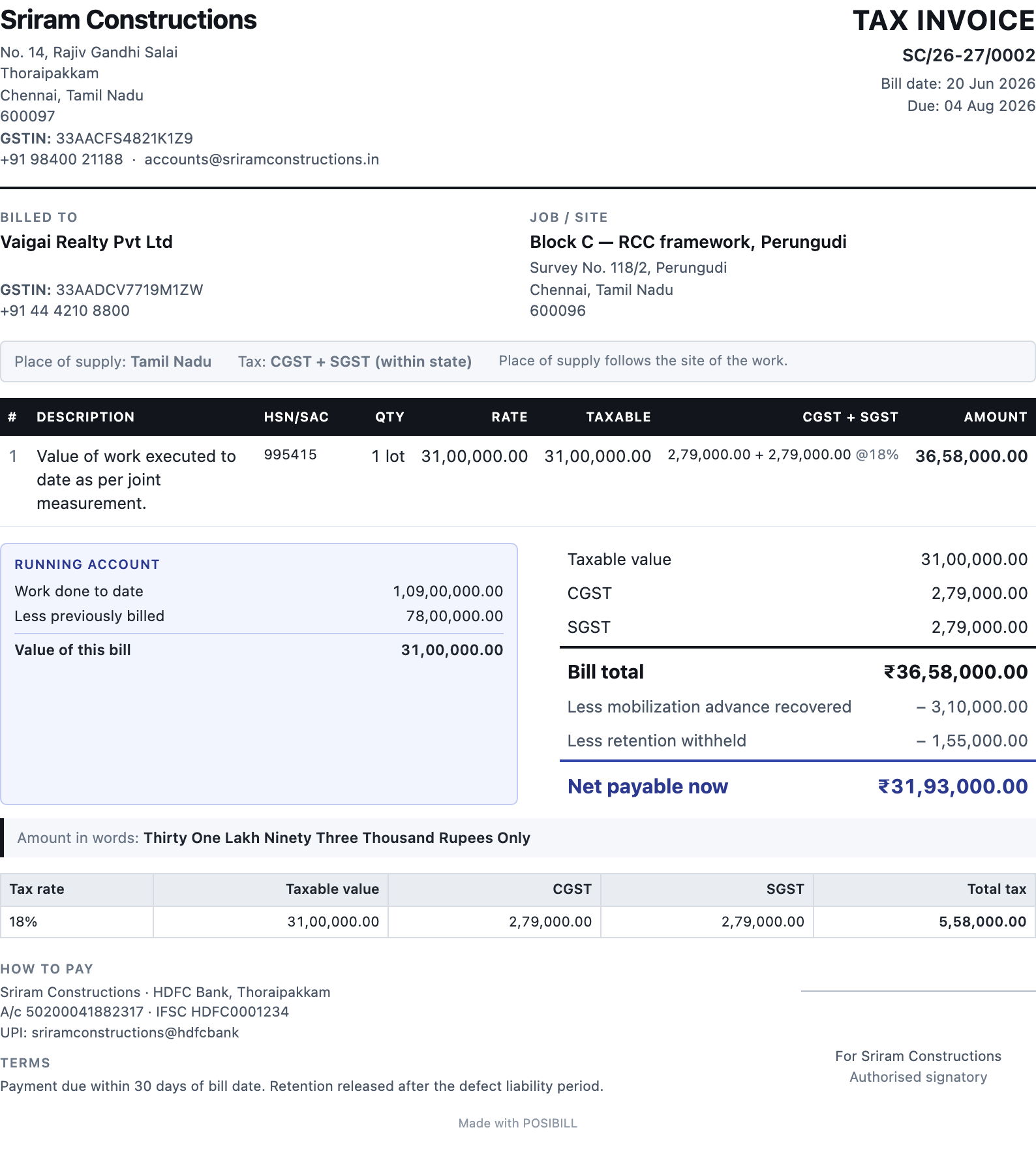
GSTIN on both sides, place of supply and why it was chosen, HSN/SAC, the CGST/SGST or IGST split, a tax summary by rate, the amount in words, and your bank details. Plus the running-account box a builder's QS actually looks for.

  • Numbered per financial year, resetting 1 April
  • Immutable once finalised — corrections are a cancellation and a replacement
  • Identity is snapshotted, so a five-year-old bill still shows the address it was issued from
A POSIBILL tax invoice PDF, showing the contractor's letterhead and GSTIN, the customer and job site, place of supply, the line items, a running-account box, the tax summary by rate, the amount in words and payment instructions.

Start from the Excel you already have

Upload the sheet you keep your customers and rates in. POSIBILL reads it, shows you every extracted field next to the value it came from, and writes nothing until you confirm.

A GSTIN whose check digit is wrong gets flagged as a wrong check digit — not as "invalid". A rate that says "as per site" is flagged, not imported as zero. You fix the handful that need fixing and import the rest.

  • Nothing is written before you confirm it
  • Failed rows can be corrected and retried without re-importing the good ones
  • Skippable, and still there in the checklist afterwards
The import review screen: four customers read from a spreadsheet, each extracted value shown with the source value it came from. One row is flagged because its GSTIN check digit does not match and its state, typed as Karnatka, was not recognised. Nothing has been written yet.

On site

It works on the phone in your pocket.

Because you check what a builder owes you standing on a slab, not sitting at a desk. Big type, tabular figures, and nothing that needs a mouse.

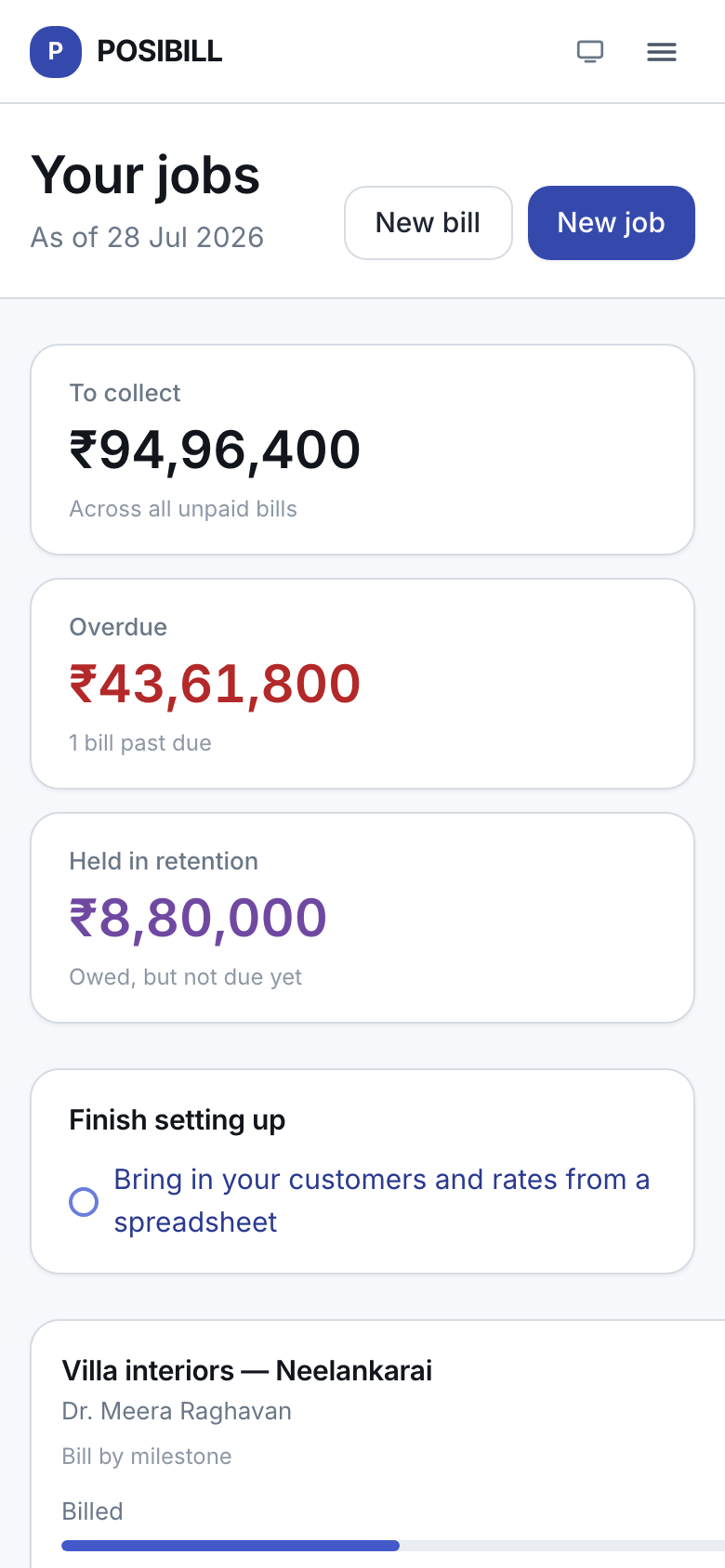
POSIBILL on a phone, showing the job list with money owed against each job.
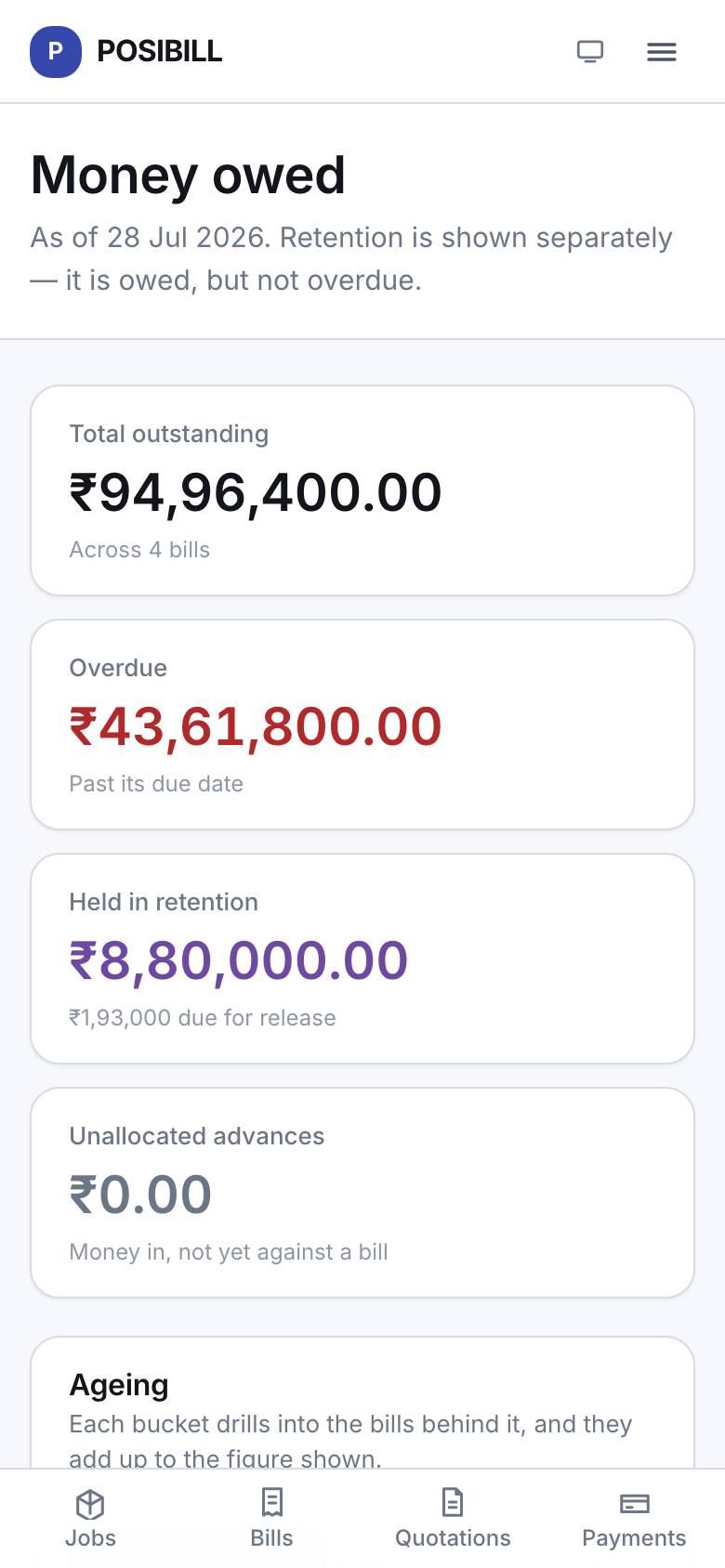
POSIBILL on a phone, showing the money owed screen with ageing and retention.

Price

₹500 a month. That's the whole price list.

One business, unlimited jobs

₹500/ month

About what one wrongly-billed slab costs you.

  • Unlimited jobs, bills, quotations, customers and rate items
  • Running account, milestone, task and whole-job billing
  • Retention, mobilization advance and TDS tracking
  • GST tax invoices as PDF, emailed to your customer
  • Excel migration, and everything you import stays yours
Create your account

No card to start. No per-user pricing, no per-invoice pricing, no annual lock-in.

Straight answers

I already use Tally. Does this replace it?

No, and it shouldn't. Tally is your books; POSIBILL is your billing and your receivable. Your CA keeps doing what they do — you stop keeping the running account, retention and advance positions in a spreadsheet beside it.

What is a running account bill, exactly?

On a works contract you don't bill line by line — you bill the cumulative value of work executed to date, and deduct everything you have already billed on that job. So the fourth bill on a ₹1.85 crore job might be ₹25 lakh even though the measurement sheet says ₹1.34 crore.

POSIBILL holds the job's billed position and does that subtraction for you. It also refuses, at the database level, to bill the same position twice — so two people finalising at once still produces exactly one bill.

My site is in another state from my office. Which GST applies?

For work on immovable property the place of supply is where the property is, not where your customer is registered. So a Chennai contractor working on a Bengaluru site charges IGST, even if the builder's registered office is in Chennai.

POSIBILL takes place of supply from the job site, shows you which field it came from and why, and lets you override it deliberately before you finalise. It is never silently computed and never silently changed.

Can I run different billing models for different customers?

Yes — the billing model belongs to the job, not to your business. Run running account for a builder and fixed-fee milestones for a homeowner in the same month, each with its own retention and advance terms. Both draw from one bill-number series, because you are one business.

What happens if I get a bill wrong after sending it?

A finalised bill keeps its number and its figures permanently. You cancel it with a reason and raise a replacement, and both stay on the record with the reason attached. That is the only honest way to handle a numbered tax document, and it is what a scrutiny expects to see.

Is my data mine?

Yes. Everything you import and everything you create is yours, and you can take it back out. We don't sell it and we don't train anything on it.

Who is this not for?

If you sell over a counter and need a POS, or you need payroll, inventory valuation or statutory books, this is the wrong tool and you'll be annoyed with us. POSIBILL is for businesses that bill against jobs — civil and works contractors, interior and fit-out firms, fabricators, electrical and plumbing contractors.

Find out what your builders actually owe you.

Fifteen minutes with your existing spreadsheet, and you'll have a receivable position you can trust — retention, advance and TDS included.